
Showing posts with label Dark books. Show all posts
Showing posts with label Dark books. Show all posts
Thursday, 31 August 2017
A love of French and Belgian Children's Books and a question - Are we done with 'dark and wordy' books? A ReadItTorial
Labels:
Dark books,
French books,
ReadItTorial 2017,
wordy books

At the moment I've been reading a translated version of "Le Petit Loup Rouge" (The Little Red Wolf) by Amelie Flechais, which is easily one of the most stunning children's books I've seen this year. Obviously we've only just seen it in the UK (actually the US, as I'm pretty sure it hasn't officially been released in the UK yet - publishers, get on that pronto!) but the French have had the book for a while (since 2014 in fact).
Sadly, this is the case for an awful lot of French books, once again driving my desire to learn more of the language. Of course it might not seem important for picture book fans to be able to thoroughly read and translate what is largely an illustrated children's book, but it does make a world of difference in understanding the subtleties of the language, and what's often lost in even the best translations to English.
We've read through a few French-only books before, most notably "La Visite De Petite Mort" by Kitty Crowther. Some of Kitty's astonishingly brilliant books have been translated, but so far not this one - which is a crying shame.
You see over the channel in France and Belgium, children's authors and illustrators are still gloriously in love with the darkly tinged children's stories that we seem to have lost all taste for (at least editorial taste, I'm pretty sure there's still a huge consumer demand for darker children's stories that aren't all fluffy bunny wunnies or cute kitties).

The main protagonist, the most adorable red-hooded wolf you'll ever meet in a book, doesn't always have a smooth ride as the story unfolds. He is tricked, he becomes victim to a rather horrid (though seemingly adorable) little girl, and he cries bucketloads when it seems all is lost.
As much as we celebrate books that deal with children's emotional states, we don't see books that tap into their fears, anxieties and concerns in a constructive way.
Perhaps there's a misapprehension that darker children's stories are too disturbing for our cotton-wrapped delicate little wallflowers who are never told 'no' and aren't frequently confronted with situations that put them outside their comfort zone.
We've championed darker books on the blog before, always careful to draw a line between what's comfortably acceptable when it comes to darker children's stories, and what's clearly beyond their age group.
It feels almost like literature is the one area where parents are overtly protective of what their children consume. Parents seem happy to let their kids loose on age inappropriate movies or videogames and yet won't let them read books that they feel are 'too old' for them. I wonder why this is? Again, with the caveat of stating categorically that it's pretty flipping obvious when something's going to be disturbing or too much for your child, but it does feel like there's an odd imbalance here.

Again, referring back to "Le Petit Loup Rouge", this isn't a book that's over and done with in such a neat little timeline. It's a book that ditches the laconic and abrupt storytelling tropes we're seeing more and more of in UK and US publishing, taking its time to deliver a wholly satisfying reading experience that perhaps does need to be chipped away at over the course of several bedtimes, but feels all the more immersive, satisfying and enjoyable for it. It almost feels like there's more consideration for the creative process, and less for 'let's make it fit, let's make it tidy, let's make it economically viable'.
J'adore French books at the moment (again, pardon my terrible, terrible language skills) and I'm beginning to think that the more books we introduce to UK / US readers from right across the world, translated or otherwise, the better off and better read we'll all be.

Thursday, 19 January 2017
"Do kids lose their ability to deal with dark stuff as they get older?" - A ReadItTorial

Apologies for skipping a week but we're back on track with our ReadItTorial slot, once again dipping into a subject that we've visited and revisited many times on the blog.
Dark books for children. Inspired by "A Series of Unfortunate Events" (possibly one of the most successful "dark" children's book series ever) getting a new small-screen treatment as a Netflix series (it's very good by the way, go watch it!) I've definitely noticed that as Charlotte gets older, she has lost some of her love for darker stories, nasty characters and perilous settings.
When we started this blog and she was a tiny little thing, I'd often grab some of the darker children's books from the library along with the usual happy-go-lucky haul. I think this is something that some parents are predisposed to, particularly if they like darker subjects and stories themselves and can't resist a cracking villain. Obviously everything we covered early on had to be tried and tested first before being deemed as fit for consumption by tiny eyes, but soon I realised she actually liked the odd jump-scare, and the 'baddies' were often the most interesting characters in those books.
Take "The Bear Under the Stairs" by Helen Cooper. I know, we've mentioned this one a HECK of a lot...

On the other hand it's a book that expertly and very visually describes exactly what it feels like to be a child, at that age where pretty much anything still feels possible and plausible, and even the most innocent old fur rug tucked under the stairs can look like something altogether more menacing.
The first time we read this book together it gave Charlotte nightmares and that was pretty much reflected in our first review.
Weirdly though, she came back to it and demanded we borrowed it from the library (we've since added it to our collection, just because it's such a fantastic book). Almost like she LIKED being scared by it but once she'd got over the initial way the book worked on her, she began to really love Bear.
Back when she was very tiny, I hadn't the foggiest idea what being a dad was all about. I fell into the same traps I'm sure many new dads (and quite a few new mums) do of not quite thinking things through before launching into them. I developed a very gruff gravelly voice for Bear even though he doesn't actually have any 'spoken' lines in the book. I'd add these little comic asides to describe his actions, fitting them alongside William's own story in the tale. Stupidly I think these probably made the whole book feel more menacing than it actually was but it's interesting to see other folk's opinions on this one, not feeling that it's a dark book at all.
But it does work on a child subconsciously, and I think that's perhaps why later on children lose the ability to pass something off as merely being in someone's imagination, and pick up more on emotions and feelings of characters who are quite obviously in distress.
Going back to "A Series of Unfortunate Events" I wondered how the TV show would deal with a moment that underlines exactly what a complete b*****d Count Olaf actually is. Early on in the book when Klaus, Sunny and Violet have dutifully cooked dinner for The Count and his awful acting troupe / band of henchmen, Klaus says something particularly smart back at Count Olaf, and receives a ringing smack around the face for doing so.
The earlier movie adaptation of the books featured the slap, the TV show didn't shy away from it either - and this is a bit that really does hit home (if you'll pardon the tasteless pun) that Count Olaf is more than a pantomime baddie who snarls at the audience, to be booed at. This is an evil character who has almost no redeeming qualities whatsoever (though the TV show is beginning to lay the groundwork for the later books where we discover that The Count has more reasons to hate the Baudelaires other than the frustration of not getting his filthy hands on their massive fortune - no more spoilers, you need to read the books as they are brilliant!)
The slap is something that would rule out me letting Charlotte watch this show, and it's something we gently skipped over in the books (I'm pretty sure many parents "abridge" books to read around bits they know are unsuitable for their younglings, right?) but it is a pivotal part of building Olaf's character up to be exactly what it is, a dark villain that should not be trusted an inch.
As I get older, and thanks to a good dose of sensibility from my wife, I find I'm getting more touchy and sensitive about darker books myself - well, for Charlotte's consumption at least. Now and again we vet chapter books that we know would probably disturb her during before-bed reading but it's so very tough to do this when you've very little indication of a book's content if it's A) brand new and B) all you've got to go on is a very short summary.
Of course, 'dark books' are the darlings of the press who love to point out that as children become ever-more desensitised to horrible people and horrific events, authors and illustrators of dark stuff have to up their game until they're treading firmly on the toes of subjects and characters that would make many adults wince. Are we rapidly approaching a point where dark books are a quaint thing of the past because kids have seen it all before by the time they reach the tender age of taking their own first faltering reading steps on their own?
Thursday, 25 June 2015
"Why kids love mischievous characters and dark themes more than goody two-shoes and cuddly fluffy bunnies" - A ReaditDaddy Editorial
Labels:
A ReadItDaddy Editorial,
Bad Kids,
Dark books,
Scary Books
 |
| Beryl the Peril from Topper / Dandy Comics. Put her in a room with Madeline and see who wins! |
Twitter is a great source of topics for these little editorial articles. A recent debate talked about the reasons children like naughty characters and dark stories, in essence, why are children always attracted to books and stories that would make a Victorian maiden aunt scamper for the smelling salts?
Most parents and teachers will know the answer to this. Kids are not always the blessed little angels we imagine them to be and Charlotte is no exception. In case I've somehow mistakenly led regular readers to believe that she is, in fact, Walter from Dennis the Menace (albeit a female version) or a wondrous virtuous and perfectly well behaved version of Matilda from the Roald Dahl story, nothing could be further from the truth.
She's very polite and well behaved - most of the time - but I noticed that she always reacts favourably to stories where kids are little terrors, smart, naughty and conniving and it struck me why time and time again kids love reading about characters like these.
She also loves stories that explore darker themes. Not horrible mind-bendingly disturbing stuff, but stories that take a walk on the wild side exploring themes that deal with childhood fears, monstrous entities and villainous schemes.
Of course, naughty characters and dark themes are nothing new. Take Dennis the Menace (who is fast approaching his 66th birthday!) Dennis's behaviour in issues of "The Beano" probably isn't really that bad by modern standards (I don't think I ever recall reading a Dennis the Menace story where he purposely vandalised his neighbours car purely because his neighbour shouted out of the window at him) but for certain kids, Dennis's cheeky antics almost make him into a folk hero. He always gets the better of his dad (point of observation here as Charlotte is a bit of a Beano fan, when did Dennis's dad mutate from a tall Hitler-moustached pin stripe suit wearing comb-over slipper wielder into a sort of taller version of Dennis himself?), he usually gets the better of his teachers, and despite all the influence and money at his disposal, Walter never manages to quite win one over on Dennis or his ever-present poochy pal Gnasher.
Kids, of course, would never want to read a story where Dennis somehow saw the error of his ways and became a polite and well behaved little chap overnight. Living a vicariously naughty life through a favourite story character is a huge part of the appeal, so it's easy to see why kids also love dark and scary books.
There's a different set of criteria that can be readily identified in successful dark children's books, and sometimes books can be dark and scary to children when their intention is quite the opposite. Take Jon Klassen and Lemony Snicket's "The Dark" (a book that, like so many other dark and scary books, hit our Book of the Week slot with consummate ease).
 |
| Jon Klassen and Lemony Snicket's "The Dark" - Let me count the ways we love this bit where Laszlo says "Hi dark, hi!" |
When I first read this to Charlotte, on a dark night before bedtime, the message in the book (a positive message that the dark wasn't actually to be feared) was lost on her completely - perhaps in some part because I adopted a dark whispering voice for the dark (stupid daddy) or perhaps because the book's summary - "The dark is always there!" isn't really something children want to think about too closely when they're about to switch off the light themselves.
Oddly though, I expected Charlotte to hate the book, to never want to hear it again but the very next night she demanded it again, and the night after that (and so on until I really thought we ought to read something else, as I gently pointed out that we're supposed to review lots of books not just one!)
Along similar lines, Levi Pinfold's utterly sublime "The Black Dog" also sniffed its way into a Book of the Week award like a big Jeffy...
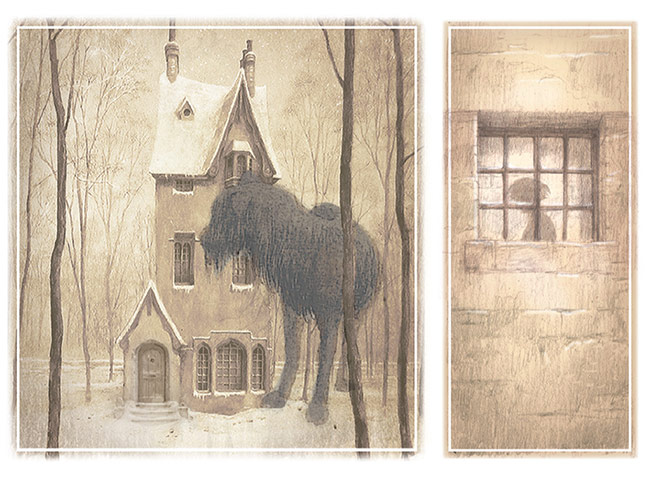 |
| "The Black Dog" by Levi Pinfold. Has there ever been a more darkly beautiful children's book? |
The story's central message this time is that no matter how tiny you are, you can still be brave in the face of something very big, dark and scary. Again Charlotte had a love-hate thing going for this book while we were reading it for the first time, but as the story reaches its conclusion it becomes uplifting and positive, and was in constant demand for weeks (and still is).
When we sat down to talk about this editorial idea, I asked Charlotte what her scariest book was. That's quite a question for a 7 year old who (to date) has contributed to and either read or had read to her over 2000 books but without a pause she picked quite a surprising one...
 |
| "The Bear Under the Stairs" by Helen Cooper. Scary Beary! |
Helen Cooper's sublime "The Bear Under the Stairs" has been reviewed here a couple of times. First time we read it and reviewed it, it gave Charlotte nightmares so my first review reflected this and we relucantly gave up our library copy very soon after we'd loaned it.
An odd thing happened though. On our next library visit, Charlotte wanted it again - and wanted it read. Knowing what to expect second time around, it switched from being a book that worked psychologically on a child's fears (both visible and imagined) to a book where Charlotte knew that the bear actually wasn't there to harm William - and though William's mum (and later evidence in the story) hinted that it might have been an imaginary bear, the bear was actually real.
We got into quite a deep discussion about whether bear actually was there and the final scene of bear parachuting into another child's house is a delicious bit of double-switching by Helen, almost cycling the story back to page one again.
It got me thinking about things that adults find scary. I can honestly say, hand on heart, that I have never really read a piece of fiction that's scared me (even as a child I also loved the dark stuff and we had some corkingly good ghost and supernatural stories when I was growing up in the 1970s and 80s) but books that scared me as a kid were always non fiction. True accounts of horrors in the real world, that kept me awake at night (I remember staying at a relative's house when I was about 10 or 11, and idly poking through their book case for something to read - ending up with a rather horrific and graphic non-fiction account of the Christie murders at 10 Rillington Place. Eesh!)
It must be the toughest thing in the world to get that balance right for kids. Too naughty or mischievous and kids will assume your character is a baddie, and won't want any truck with him or her. If your story is too dark, too obviously disturbing, kids will just stop reading. Not dark or scary enough and kids will see through a thinly veiled attempt to spook them. We'd love to hear your best examples of books where the main characters seemingly get away with being absolute rotters - and also your fave scary and dark stories for kids. Do comment below!
Subscribe to:
Posts (Atom)


 Posts

