
Wednesday, 22 April 2015
When Dad Showed Me the Universe by Ulf Stark and Eva Eriksson (Gecko Press)
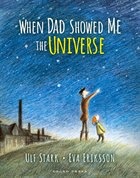
When Dad Showed me the Universe
Written by Ulf Stark
Illustrated by Eva Eriksson
Published by Gecko Press
We are always stargazing. We're lucky enough that on a cold dark night when the sky is clear, we can see quite a lot of the stars without too much light pollution (amazing considering we live in a busy town centre). Recently on holiday up in the Peak District we could really soak up the stratosphere as we lay in our hot tub (oooh, get us!) and sat silently picking out the constellations in our 'different' patch of sky.
And so, to this wonderful book celebrating stargazers everywhere. "When Dad Showed me the Universe" is a voyage of discovery for a boy who embarks on an evening adventure with his dentist dad.
Dad stops off for some supplies (he's a dentist so no sweeties, just a pack of chewing gum!) and the two of them head out into the best place to view the stars - the middle of nowhere!
Dad explains all about the amazing starscape laid out before them, and all the constellations - some of which may have already disappeared, but still visible to us because their light takes so long to reach us.
The story is wonderfully told and illustrated. Poor dad though, I definitely identify with his final annoyance in the story (this also seems to happen to us on far too regular a basis so we definitely sympathise!)
Charlotte's best bit: Poor dad needing to scrub his boots clean at the end of their eventful trip. We know that feeling all too well, sadly.
Daddy's Favourite bit: A touching story with an all-too-rare book dad that isn't just there for comedy value - which makes a very nice change in a children's book, I must say!
(Kindly sent to us for review by Gecko Press)

Tuesday, 21 April 2015
Come to Discover for a brilliant Bear Hunt spectacular from October 2015
 |
| Image Credit (C) Helen Oxenbury |
Michael Rosen’s Bear Hunt, Chocolate Cake and Bad Things at Discover
Michael Rosen and Helen Oxenbury's classic children's book "We're going on a Bear Hunt" is coming to our favourite book and story venue, Discover Story from the 16th October 2015 to Spring 2016
Discover Children’s Story Centre in Stratford, East London is launching an exciting new interactive family exhibition, ‘Michael Rosen’s Bear Hunt, Chocolate Cake and Bad Things.’ Discover’s exhibition will explore the fantastic stories and poems of former Children’s Laureate and bestselling writer Michael Rosen. Children and families can walk into immersive environments inspired by We’re Going on a Bear Hunt, Chocolate Cake, The Book of Bad Things and Uncle Gobb and the Dread Shed.
Children can step inside a huge chocolate cake (YESSSSSS!!! We are SO there!), discover a secret larder, swishy swashy their way through a Bear Hunt and explore Bad Things in the Dread Shed. The exhibition will feature hidden rooms where clues can be found that reveal the inspiration behind Michael’s writing including his Grandparent’ sitting room and his classroom. Younger children will be able to participate in a Bear Hunt trail whilst older children can go on a fun fact finding mission and create poems of their own to takeaway.
Discover’s Joint Chief Executive, Sally Goldsworthy said, ‘We are very excited to announce this latest exhibition made in collaboration with Michael Rosen. Michael has so much energy and passion for education, creativity and writing that he is incredibly inspiring to work with.’
Award winning author Michael Rosen said ‘This exhibition is one of the most exciting things to have happened in my writing career. I am someone who has found a way of writing that is often about digging up stuff to do with my past and here is Discover making that into a giant room that families and schools will be able to explore. Just as exciting for me, as someone who works with children and students at Goldsmiths, University of London, is the idea that this exhibition will act as a springboard for children, teachers and parents to talk together about things that they remember or think up, and this, I hope, will turn into writing and performing new poems and stories. I am so looking forward to it.’
Discover’s new interactive exhibition for families Michael Rosen’s Bear Hunt, Chocolate Cake and Bad Things opens on 16th October 2015 and will launch the centre’s autumn programme full of inspiration from Michael Rosen’s stories and poems.
Discover Children’s Story Centre’s exhibitions have been nominated for the 2012 European Museum Academy International Children’s Museum Award. Michael Rosen’s Bear Hunt, Chocolate Cake and Bad Things follows hot on the heels of blockbuster exhibitions Once There Was...The Wonderful World of Oliver Jeffers, Secret Agents, Journey to Space and sold out collaboration with Punchdrunk Enrichment, The House Where Winter Lives.
Michael Rosen’s Bear Hunt, Chocolate Cake and Bad Things has been created, produced and designed by Discover Children’s Story Centre and will be touring the country from summer 2016. Mark October in your diary, it's going to be a smasher!
50 things you should know about the First World War by Jim Eldridge (QED Publishing)

50 Things you should know about the First World War
Written and Illustrated by
Jim Eldridge
Published by QED Publishing
We're catching up with an amazing book about the First World War, first published in 2014 - the centenary year of the conflict - and packed to the gills with facts and figures, historical and statistical snippets and an in-depth look at the people, the technology, and the appalling cost of the war to generations of soldiers and their families.
You'll find out what triggered the conflict through political discussion of the state of the world at the time by examining a "Who's Who" on both Axis and Allied sides. Detailed descriptions of the conditions troops faced really underline what a terrible atrocity the war was, and how the human toll affected generations to come.
This has been an astonishing book to delve into - perfect at the moment as Charlotte's school still factors both World War 1 and 2 in their history lessons. The wealth of information packed between the covers of this authoritative guide make it one of the best books covering the First World War that we've seen to date.
Charlotte's best bit: A fascinating fact-filled non fiction book that highlights the horrors of the First World War
Daddy's Favourite bit: Seriously in-depth, brilliantly compiled - a must for any children currently studying or learning about the First World War at school
(Kindly sent to us for review by QED Publishing)
Monday, 20 April 2015
100 Great Children's Picture Books by Martin Salisbury (Laurence King Publishing)

100 Great Children's Picture Books
Written by Martin Salisbury
Illustrated by Various
Published by Laurence King Publishing
This is a truly fascinating picture book resource that perhaps should've been called "100 Great Children's Picture Books you have never seen before, but will be absolutely blown away by!" Picture book expert Martin Salisbury has compiled a mouthwatering treasure trove of children's books stretching right back to the very beginning of the illustrated picture book format for children, and showing that all the ideas, art styles and amazing writing we know in children's picture books today has roots that go back as far as the late 19th century.
With a ton of photographs of Martin's enviable collection, you'll find many many works that will provide inspiration and insight to anyone who's interested in children's books, whether you write them or write about them, illustrate for them or are a parent who has a few loft treasures tucked away in the attic that you really ought to bring out and dust down.
 |
| "The Slant Book" by Peter Newell - A really simple but hugely effective idea with glorious illustrations |
 |
| Lucy Brown and Mr Grimes by Edward Ardizzone - Utterly fantastic! |
Some well known artists and authors, as well as some you've never heard of before, are featured in this exhaustive tome thoroughly researched and beautifully presented. We were completely wowed by some of the booky discoveries we made while leafing through this big thick and satisfying collection including works by Edward Ardizzone that we'd never heard of before (he's a bit of a 'thing' for us at the moment, thanks to recent reprints of his fantastic "Little Tim" books, one of which is featured in this collection).
What struck me was how ideas you'd imagine were fairly new and modern were actually nothing of the sort. Ingenious tricks like using cutouts in pages, or 'lift the flap' books have actually been around for a very long time, pioneered back when limited print runs of books came nowhere near approaching the sort of numbers modern publishing deals with.
 |
| "Say with Me" - A completely entrancing and beautiful book from Poland. |
This is a luxurious book to get lost in for hours and as mentioned before, it's hugely inspirational particularly if (like me) you love a good scribble and want some new ideas or new directions to go in with your art.
A truly magical collection.
"100 Great Children's Picture Books" by Martin Salisbury is out today from Laurence King Publishing, RRP £24.95.
Charlotte's best bit: Too many favourites to choose from amongst these gorgeous books but she really loved the look of the original Moomins Cut Out Books and a Babar story she hadn't previously heard of
Daddy's Favourite bit: Loved the simplicity behind the "Slant Book" - Such a great idea! All in all, a glorious and inspirational collection of children's books, most of which we'd never heard of but really want to find out more about. Brilliant!
(Kindly sent to us for review by Laurence King Publishing)
3D Bubble Writer - a Crazy Craft Book by Linda Scott (Laurence King Publishing)

3D Bubble Writer - A Crazy Craft Book
Written and Illustrated by
Linda Scott
Published by Laurence King Publishing
This fantastic and inspirational craft book arrived just in the nick of time to stop us from going completely insane with boredom over the long (3 week long!) Easter Holidays. Charlotte loves doodling and scribbling, so what better way to get some inspiration for new craft projects than from a book absolutely packed to the gills with brilliant ideas.
"3D Bubble Writer" by Linda Scott gets children thinking about a subject particularly close to my nerdy typography-obsessed heart. I love fonts, I love lettering and it seems to be a bit of a lost art for folk to dabble in drawing up their own letter forms.
Linda's book breaks us in gently by showing us a few simple but hugely effective ideas to jazz up our own efforts, starting with the titular 3D Bubble Writing - but not stopping there, oh no! There are fantastic resources and exercises covering all sorts of magical 'makes' from your own pop-up cards and messages, to more intricate papercut designs from original sources of inspiration spanning the globe. Mexican bunting? You know we're going to love a bit of that!
 |
| Patchwork Lettering? Cool idea! |
The great thing about this book (apart from the fact that it's inspired Charlotte to such an extent that she's just about covered all of her school work books in whizzy and sophisticated new nameplates and lettering - Ulp!) is that each of the exercises and projects appeal to a hugely wide range of age groups. Tinies can get stuck in making their own lettering mobiles while older kids can tuck into the more sophisticated makes on show here. With an adult to help where tricky cutting out is required, you'll soon be producing fantastic crafty creations with Linda's expert guidance.
 |
| Make your own fantastic paper-chain alphabet! |
The book contains glorious and colourful press-out card 'makes' as well as showing you how to draw your own designs (you can even draw on the book, if you're the sort of person who doesn't run screaming into the trees at the very suggestion of defacing books!! Eeeks!)
What a fab book to dip into again and again, particularly on those long wet April Showers-ey days at home.
"3D Bubble Writer - A Crazy Craft Book" by Linda Scott is available from Laurence King Publishing today!
http://www.laurenceking.com/en/3d-bubble-writer/

Charlotte's best bit: Experimenting with shadows, shading and pop-up shapes for her lettering creations! Fancy!
Daddy's Favourite bit: A huge thick jam-packed book spilling over with fabulous and inspirational artsy ideas! We utterly love it!
(Kindly sent to us for review by Laurence King Publishing)
Friday, 17 April 2015
ReadItDaddy's Book of the Week - Week Ending 17th April 2015 - "The Hog, The Shrew and the Hullabaloo by Julia Copus and Eunyoung Seo (Faber and Faber)
Labels:
Book of the Week 2015,
Eunyoung Seo,
Faber and Faber,
Julia Copus,
The Hog,
The Shrew and the Hullabaloo (A Harry and Lil Story)

The Hog, The Shrew and the Hullabaloo
Written by Julia Copus
Illustrated by Eunyoung Seo
Published by Faber and Faber
We loved "The Hog in the Fog" very much indeed - in fact if you peek inside the cover of this, the second book in the "Harry and Lil" series, you'll see a recommendation from us! Fame at last!
But you know what? We loved this second book even more - Harry the Hog and Candystripe Lil (the most adorable shrew ever!) are back for a second adventure - this time centred around a very restless night for our bristly buddy Harry.
There's a strange noise going on, and poor Harry is a tiny bit scared. Luckily his best friend Candystripe Lil sees this as a great opportunity to offer her friend some comfort, and stop by for a sleepover too. Tucked up in bed, the two can hear the gentle breeze but the night is also full of odd noises as nocturnal creatures come out to play. Who can we find snuffling around the forest at night? Who sings a gentle lullaby down by the pond as dusk falls?
There are stories that are perfectly put together for snuggledown bedtime reading and "The Hog, The Shrew and the Hullabaloo" is just such a book. Wonderful pitch-perfect rhymes and adorable detailed illustrations not only make us want to read about Harry and Lil's world, and their adventures, I think we'd quite like a holiday there too (but we'd definitely take Lil's cue and pack some earplugs!)
Charlotte's best bit: Charlotte loves the rhymes and adores picking out all the tiny little details in the illustrations (we loved Harry's Tennis-ball-topped curtain rails!)
Daddy's Favourite bit: Snuggly, cuddly, pretty much perfect!
(Kindly sent to us for review by Faber and Faber)
Like this? We think you'll love these too!
The Hog in the Fog by Julia Copus and Eunyoung Seo (Faber and Faber)
Thursday, 16 April 2015
You Can't Take an Elephant on the Bus by Patricia Cleveland Peck and David Tazzyman (Bloomsbury Publishing)
Labels:
Bloomsbury Publishing,
David Tazzyman,
Patricia Cleveland,
You Can't Take an Elephant on the Bus

You Can't Take an Elephant on the Bus
Written by Patricia Cleveland-Peck
Illustrated by David Tazzyman
Published by Bloomsbury Publishing
Have you ever tried to sneak a zoo animal onto public transport? No, neither have we but in "You Can't Take an Elephant on the Bus" we find out that not only is it inadvisable to try and cram a pachyderm into a charabanc, it's generally not a great idea to take a Tiger onto a train (oh how we hoped the Tiger would take a chomp out of the irritating businessman on his phone, slopping his expensive coffee about all over the place).
Crazy rhymes are the order of the day from Patricia Cleveland Peck - and even crazier illustrations courtesy of David Tazzyman (who we somehow managed to miss getting a credit on the cover of the book - his name features on the big bouncing beautiful red bus itself!)
There is, however, one form of transport that just about any animal - elephant or whale, monkey or pig, tiger or giraffe - can enjoy but we won't spoil the big reveal!
Charlotte's best bit: The skateboarding piggie! Oink!
Daddy's Favourite bit: Fun and bouncy book more suitable for younger readers who will love its craziness!
(Kindly sent to us for review by Bloomsbury Publishing)
Wednesday, 15 April 2015
Beautiful Beasts by Camilla de le Bédoyère (QED Publishing)

Beautiful Beasts
Written and Illustrated by
Camilla de le Bédoyère (Author)
Published by QED Publishing
There seems to be a huge surge in the publication of fantastic non-fiction books about animals. In the last year or so we've seen some brilliant books concentrating on species we know, and even some mythical ones we don't. But how about an utterly fantastic book that traces the genesis of many of the animal species that still roam the earth today?
"Beautiful Beasts" mixes together the ancient and the modern, providing a luxurious and sumptuous fully illustrated look at how certain animal classes and 'families' evolved often from common ancestors to become the animals we're more familiar with in the here and now.
Camilla's enthusiasm shines through as we see how the first single-celled creatures evolved into more complex beasts, emerging from ancient seas to eventually stalk the land. Evolving further still as the first primitive mammals and birds emerged, and the first apes swung through the trees before standing upright and turning into...us!
Charlotte was completely enthralled by this, and relished the challenge of pronouncing some of those weird old names for some of the ancient creatures nestling between the pages of this weighty tome.
An utterly brilliant addition to our burgeoning bestiary! "Beautiful Beasts" is out today, from QED Publishing.
Charlotte's best bit: Charlotte was completely fascinated by the evolution of horses from Eohippus onwards.
Daddy's Favourite bit: A really fantastic bestiary to join the ranks of the amazing creature books that are currently storming into bookstores. Not to be missed!
(Kindly sent to us for review by QED Publishing)
Two truly beautiful books for your tinies from Wide Eyed Editions - "Colours" and "One Thousand Things"
Labels:
1000 Things,
Colours,
Wide Eyed Editions
 |
| "Colours" by Aino-Maija Mesola (Wide Eyed Editions) |
By now you've probably spotted that we're falling completely in love with Wide Eyed Edition's fantastic range of gorgeous books but don't let your tiniest of tinies miss out as there's plenty in the range for them too.
Starting off with "Colours" by Aino Maija Metsola, little ones will love this large format hardback book with tons and tons of lift-the-flap fun. Learning colours and shapes, object names and having lots of fun doing it is the order of the day here as each page spread reveals more and more to explore. Even busy and curious 7 year olds can't resist diving into this book to see what's hiding inside.
 |
| One Thousand Things by Anna Kovecses (Wide Eyed Editions) |
Just as stunning is "One Thousand Things" by Anna Kovecs, again from Wide Eyed Editions. Even more to explore for busy little tiddlers as they follow their first words with the help of gorgeous Little Mouse. Your furry guide through a whole world of discovery, with some truly wondrous discoveries to make along the way.
Both "Colours" and "One Thousand Things" are available right now from your fave indies and local bookshops, so if you're on the lookout for a fantastic present for book-obsessed toddlers, these are utterly perfect!
Tuesday, 14 April 2015
Zen and the Art of Self-Publishing Children's Stories Part 2 - "Where am I going wrong?"
 |
| Self publishing children's books. John Bull Printing Set Not Required |
Regular blog followers of yore will recall that we used to spend a lot of time and effort championing the cause of Self-Published authors and illustrators. Our good old 'Indie Pen-Dance Wednesday' might've been one of the most pun-dreadful titles ever for an indie book slot but we took a look at a title a week, and published honest critiques of each book we read. We also published an article entitled "Zen and the Art of Self-Publishing Part 1" where we came up with ten top tips for would-be authors and illustrators delving into the world of self publishing.
Time has passed, life and jobs have changed, our spare time for writing the blog shrank away and we had to make a decision to cut our blog content, first paring off app reviews (which we were never very good at anyway) then self published titles. The decision to chop self-published and small indie coverage wasn't an easy one to make but for many reasons we moved towards reviewing things we genuinely wanted to read and as Charlotte got older, we could no longer review books that really weren't our cup of tea.
We still keep an eye on what's going on with self-published and small independent pressings though. Why? Because some folk really do push the boundaries of what you'd expect from self published authors and illustrators. For all the champions out there though, there are some who still don't quite understand why their books are failing to capture the intended audience. So let's have another look at some of the common problems we see with self published and small indie books now we're more prone to buying them ourselves when we spot a corker.
Here's ten more tips to help steer you straight if you're lost in the mire of putting out your first self-published work:
1) Seek criticism outside your comfort zone. Friends and family love you, and will inevitably be polite. Genuine constructive critics will give you an honest (sometimes brutal) opinion so seek them out!
Creative folk are wonderful human beings. Sometimes though, they need to really take heed of the first point we raised when we last produced a list of 10 "dos and donts" for self published children's books. Go and seek criticism out from sources that aren't close to you - trade the friends, family, siblings, children for folk who know their subject, know children's books, know how to write, know illustration inside and out, and won't shy away from telling you if your book is terrible. Yes, this is a scary prospect but is it any more scary than facing someone who's paid money for your work and isn't at all happy with their purchase, and takes to a public forum to say as much?
As an additional word to the wise on this point - please PLEASE do not pester authors and illustrators on Facebook or Twitter, asking them to help crit your work. They're busy professional people too, who really don't want to spend every waking hour on social networks fending off well-meaning, enthusiastic but ultimately overbearing would-be children's authors or illustrators who want their work given the once-over.
2) We can't stress this enough as it still seems to be one of the biggest problems with self-published children's books - If you can't draw, don't draw. If you think you can draw, don't draw. If you KNOW you can draw, go right ahead but still seek someone else's brutally honest criticism first!
The number one thing that lets self published children's books down is the number one thing that can make or break a children's book in any marketplace, commercial or otherwise.
The art. Starting right from the beginning, your cover is your introduction to your intended readership. If your cover sucks (and so, SO many do - in fact there are some pretty cruel blogs and tumblrs out there that take great delight in publishing the very worst Kindle book cover art) then your reader will instantly assume that the rest of your book is of similar quality! Thinking you're doing something whacky and cute because you draw your entire book in a child-art style is possibly the worst thing you can do. Kids can already draw like that, they want slick artwork "like grown-ups do" not stuff they could probably do better themselves. Sorry, but that really is worth reiterating.
Don't just stick a stock image on there either, with some hideous word-art font - and if you do resort to stock art, make sure you're using royalty free stuff not just an image you've spotted from a google image search.
Book design is also an art form in itself. If your book is badly laid out, difficult to follow, contains totally unreadable typefaces (and a mix of those liberally sprinkled throughout the text like pepper on a baloney sandwich) AND the in-book illustration sucks as badly as the cover art, people will round-file it quicker than you can say "cream cracker". Children's books adhere to some fairly strict rules when it comes to things like page layouts and page counts with good reason (google on the subject of children's book design and you'll see a huge wealth of really great websites showing you how to improve your book no end).
Some people do successfully bend those rules, or tweak them but when they break them, the results are often disastrous.
It's worth also pointing out that there are a ton of brilliant illustrators out there looking for commissions. Hire one, pay one, give them credit, and make your book shine but again, like any professional, do not badger them to work for free. They wouldn't expect you to come round to their house and fix their plumbing for free, after all!
3) Be mindful of other people's time. Time is more precious to anyone (particularly book bloggers) than a free book, even yours!
Some folk used to assume that we did nothing all day but write about children's books. Sadly, no one I know (and I know a lot of book bloggers) makes a living wage solely from reviewing children's books. Those who are parents have to juggle a hectic home life with a working life, and all the other things that happen around those too. Those of us who give up our spare time to write about books - often without payment - value time above pretty much everything else. Some folk (thankfully a minority) who approached us in the past were downright rude if we politely pointed out that we didn't review self-published or independently published books due to time constraints. Constantly trying to find polite ways to point this out was a huge deciding factor on why we dropped our coverage of self-published books. Rudeness will get you absolutely nowhere - Put it this way, if you were a chef, would you trust the opinion of someone if you had to force every morsel of food between their lips with a ham-fist before writing a dazzling critique of your restaurant?
4) If a reviewer doesn't respond the first time, what makes you think they'll respond the second, third, fourth and fifth time you ask them for a review?
Persistence is an admirable character trait in most other occupations. Sometimes though, persistence can turn very quickly into pestilence. We have a fairly clear stance on reviews that if we don't respond to you, we don't want to review your book. Other reviewers are the same - it saves having to sit there and explain why you don't want to review the book, or come up with a polite excuse why your book isn't suitable for us. In one or two cases, folk have either rudely assumed that because we've covered their previous work, we want to cover everything they do - or worse, they've actually described our taste to us as if they've magically read our minds and instantly know we're just going to ADORE their story about a cute little bunny who has lost his mummy. Pestering and nagging a book blogger or reviewer to review something takes us back to point 3 above - if you're trying to bully someone or force them into something, they're going to shut you out.
One of our pet peeves is being followed on Twitter or liked on facebook by self-published authors who we dutifully follow back, and whose opening gambit is a direct message telling us to check out their book. We've got eyes, we can see your profile, we'll see who followed us or liked us on Facebook and we'll click on your blog or website link. If we like what we see, we'll contact you to see if we can review your book (or we'll at least tweet about it or write about it off our own backs!) You're likely to be very quickly unfollowed or blocked if you push it up our noses.
5) Proofread your stuff and also tailor it for a prospective international audience if you're going for one, and don't nitpick people's reviews if they've been good enough to publish one.
I remember when we reviewed a particular title which was atrociously written but had a really good core story, and was really well received by us despite its roughness and flaws. We published a review, and the author got in touch within minutes of the review going live to pick us up on mistyping / mis-spelling a name. My reaction was to dash out an email (which was never sent) proof-reading and picking apart every mistake they'd made in their book, pointing out all the grammatical errors, jarring rhymes and awkward use of language I found. I never sent the mail but boy oh boy, if you're going to nitpick someone's review, get your own house in order first!
6) Rhymes are not easy but so many people still go all-out to bludgeon a rhyming story to death
Bad rhymes really hurt a read-aloud enthusiast. I love reading well put-together rhymes that delicately trip off the tongue with cleverness and dexterity, like little sylphs. Some self-published stories written in rhyme seem to have been written but never read. This is the only reason I can think of for the awkwardness of some of these stories. Reading them is like walking barefoot across a hard wooden floor covered in Lego. It's almost a physical pain, reading something that is clunky and unwieldy. Authors who write rhyming stories well spend a great deal of time chopping, changing, adapting and perfecting their stories until they almost SING themselves off the page. If you can confidently claim that yours do - and better still if you've managed to write a rhyming story that reads like someone would speak it, then you've done a fantastic job!
7) Cliches kill a story. Originality rocks!
Remember that "Fluffy Bunny loves his Mummy" story we talked about in an earlier example? When we look for indie or self-published stories and books, we want to see the one thing that very few of them manage to capture (and the ones that do are the ones we'll actively seek out and purchase ourselves before reviewing them). Originality, a new take on a story theme, a new quirk, a new twist, a better way of doing something than anyone's ever thought of before. When it comes to writing, we're looking for something that makes us want to hug you with glee because you've come up with something so dazzlingly brilliant and original. When it comes to illustration, we want something that shows you've absolutely busted a gut to pour your heart and soul into it in a way that makes us gasp in awe. That sounds like a lot to ask for doesn't it? But some of you out there manage it, and more than once too!
Our ten biggest turn-offs in self published children's books story themes are:
1) Cute animal stories (particularly anthropomorphic character-driven ones)
2) Overly-moral tales with a life lesson in them served like having rocks thrown at your head.
3) Pirate books. Enough with the pirates already, please!
4) "I'm your friend", "I'm not your friend", "I'm your friend again" books
5) "Stupid daddy, smart mummy" books.
6) Really appallingly written sci-fi, fantasy or superhero books for kids. Someone, anyone write a really good one and you'll corner the market!
7) Over-long stories pitched at young readers. Pick the ten best bedtime books off your shelf and time yourself reading them. That's the length you're aiming for. Longer than that, and a child's attention will wander and they'll never want to read / hear that book ever again.
8) Books that feature the protracted rhyme type. Things like "Little penny was a lovely girl. Her cheeks were red, and her hair, it did curl!" (when have you EVER heard anyone speak like that? It's like being rubbed with sandpaper then doused in vinegar!)
9) Seizing on an element of pop culture to base your entire book around. Pop culture dates quicker than cottage cheese. If you want your book to be more than a momentary distraction, build it with shelf life!
10) Stories that rely too heavily on farts, poo, wee, burps, smells, grossness etc. Works OK in the scope of a good solid story but if your book's only theme is to try and gross the reader out, it might work a little TOO well and make them want to bin the thing.
8) Ask yourself a really important question. "What do commercial books have that my book doesn't?"
Often, the answer can be summed up in one single word.
"Editing".
The key to a good book is an equally good editor. Authors may hate the snips and tucks that take place between their word processor and the finished book sitting on a shelf, but will often readily admit that a timely edit can make a huge difference. Illustrators too may hate the constant revisions and changes, but these edits make the difference between a rough diamond and a finished polished product fit for shelves.
If the best editing job you've ever done is a quick once-over with a spell checker, you may need to spend more time tweaking and polishing. The best advice I ever heard about writing a book was to stick that rough manuscript away in a drawer or hidden elsewhere for a couple of weeks. Dig it out 2 weeks later and read it again. If you're absolutely sure that it won't suffer a few nips and tweaks after two weeks of gathering dust, then make those changes, take the plunge and revise your work. Polish takes practice, time and effort but your book will be all the better for it.
9) E-Books must follow all the above rules and more
There's a (quite sadly mistaken) belief that producing an E-Book is a route to being able to slam together a slap-dash effort with a "That'll do" attitude. Wrong. Very very wrong. E-Books and apps are probably an even tougher market to crack successfully than traditional printed work. For starters, your audience's expectations are higher. E-Books or story apps that suffer from all the problems listed above will never withstand competition from slick commercial-quality fare available for the same price or less. E-books or story apps that don't make the best use of the platform they're designed for will often be overlooked in favour of apps that embrace design, ease of use and slick production. Slap-dash or shoddy work in the e-book arena screams "I just dashed this out to make money as quickly as possible" so put in the effort if you're brave enough to embrace the challenge of producing a tablet or kindle-friendly tale.
10) Look in the mirror, hold your work up in front of you and ask your mirror self the most important question of all...(and be honest with your answer!)
"Why are you doing this?" That's the most important question of all. What is your motive for throwing yourself head-first into producing stories for children? "To make a fortune?" - Forget it, seldom few children's authors make huge amounts of money from producing children's books - even those who hit the best sellers list and I doubt any of them would honestly answer that they went into writing or drawing children's books to make a mint from it.
"Fame?" Ugh, no one likes a vainglorious person - doubly so in children's books. If you've gone into this purely to raise your own profile and agenda, folk will see through that very quickly. We've never actually genuinely heard of anyone who isn't already famous trying to write children's books purely for the attached peripheral hero worship they may accrue as a result of writing for kids (worth making that point to some of the celebrities who think writing for children is a great way to bump their other career up a notch or two).
"Because I love telling stories" - OK we're getting nearer to an acceptable answer, but think about it. Do you really love telling stories? Are you the sort of person whose head buzzes and fizzes with story ideas every waking moment? If so, then you'll have a zillion and one brilliant and original ideas to commit to paper, right?
"Because I wrote stories for my own children / grandchildren / nieces / nephews / siblings - who love them - so other kids will as well, purely by the law of averages." - That's a pretty big assumption to make and if you work purely on that theory, you may find it takes a long time to find kids whose taste is absolutely in parallel with your own children's tastes.
"Because I've seen what commercial authors do, and I think I can do better than that!" - Owch. Again we're back to a previous point. If you truly believe that, then your work should be absolutely knock-out right?
(By the way, there's no right and wrong answer to this question but we'd certainly give more due to someone who did it for the love of it and that shone through in their work).
So...owch, there it is - another ten things to consider if you're taking the plunge with writing, illustrating and publishing a book purely off your own back. Some of these points may sound harsh, some of them might even sound nitpicky, but these are ten more things that can make or break a self-published book in the eyes of the folk who matter. Not the critics, not the people who may review or write about your book on a blog such as ours, but the folk who are out there browsing the web, or listening to word of mouth recommendations about things their child could read or have read to them next. As with our other list we cannot stress this enough, if you think you have taken all the above points (and the previous ten we raised) into consideration and can honestly, sincerely, hand on heart say that you have ticked those boxes, maybe one day we'll catch up with your book sometime and check it out for ourselves (and pay for it at that!)
Subscribe to:
Posts (Atom)


 Posts

